
All 17 Eldara Skills Explained
Combat, gathering, and production as one economy — plus Firemaking as a global XP lever.
Seventeen bars, one economy
Eldara ships seventeen skills in version 1.0: Melee, Range, Magic, Defence, Hitpoints, Mining, Smithing, Woodcutting, Fishing, Cooking, Fletching, Firemaking, Cultivating, Cremating, Crafting, Thieving, and Hunting. Steam calls them deeply intertwined. That is not marketing fog. Ore that never becomes a plate is a storage problem. Logs that never become arrows or heat are a missed combat upgrade. Bones that never hit a pyre are a Cremating stall.
This page is the web. For which skill to push this week, use the skill ranking board and the skill-route planner. For how a fight actually resolves, use the melee-range-magic breakdown. For the click-path that sets an action and trusts offline ticks, use the idle-loop and client primer.
Each skill has a pet. Seventeen pets, seventeen domains, permanent bonuses, and they all persist through rebirth. Steelfang, Sharpeye, Whisper, and Sprout are the named faces. Do not treat pets as cosmetics. Treat them as the reason a gathering detour still pays after you prestige. The pet bonus list and the pet value board rank the roster.
Combat cluster: Melee, Range, Magic, Defence, Hitpoints
Melee is close steel. It eats Smithing output and Hunting trophies. It is the wrong answer to skeletons that resist melee, and a fine answer to anything the Codex marks as weak to plates and mass. Range is the bowline. It eats Fletching, Woodcutting, and a calm backpack of arrows. Dragons fall to arrows. Magic is the third corner. It eats crafted implements and a respect for fire; wraiths fear that fire. You can train all three. You should specialise until food and ammo are boring.
Defence is the reason a wrong pull is a scare instead of a grave. Hitpoints is the pool auto-eat is trying to keep full. Both rise by taking fights you can survive. They are not gathering skills with a different icon. If Hardcore is in your future, these two bars are the difference between a leaderboard name and a tombstone. See the one-life Hardcore rules.
Ashen Legion reputation leans into this cluster and into Hunting. That does not make Legion mandatory for a mage. It does mean Legion donations while you are a full-time fisher will feel like paying a rival.
Gathering cluster: Mining, Woodcutting, Fishing, Cultivating, Hunting, Thieving
Mining is the underground conveyor. Veins become ore, ore becomes Smithing input, Smithing becomes melee and defence plates. High veins want better picks. Offline mining is one of the safest ways to spend eight hours at work.
Woodcutting is the surface conveyor. Logs become Firemaking fuel, Fletching shafts, and Crafting planks. If you only chop and never burn or fletch, you are stocking a warehouse. If you chop and burn, you are buying a global XP buff. Verdant Circle reputation lives on this cluster plus Fishing, Firemaking, Fletching, and Cultivating.
Fishing stocks Cooking. Cooking stocks auto-eat. Auto-eat stocks combat. Skip the middle and your idle fights die with a full crate of raw fish. Cultivating is the plant-side twin: herbs, crops, and the reagents Crafting and Cooking both want. Hunting is the animal-side twin: carcasses for the kitchen, hides for Crafting, bones for Cremating, and a natural ally of the Ashen Legion.
Thieving is the odd gatherer. It produces gold and item spikes rather than a clean ore pile. It is not a first-day activity. It is a mid-save gold tap when you understand catch risk, bag space, and how much you still need for house donations. Gilded Hammer players like the gold. Everyone else should unlock it after food and tools exist.
Production cluster: Smithing, Cooking, Fletching, Crafting, Cremating, Firemaking
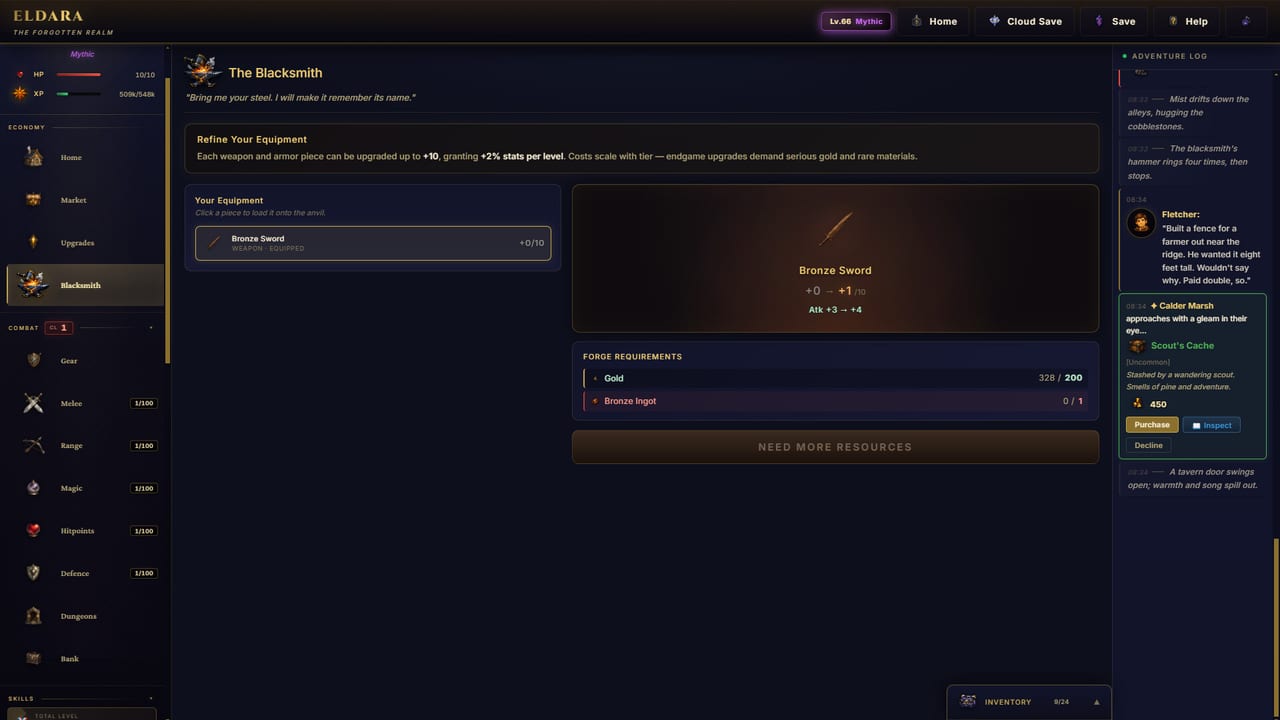
Smithing turns Mining into weapons and plates. It is the Gilded Hammer’s favourite child. A rebirth that stamps +5 refinement onto equipped combat gear assumes you had something on your body worth stamping; Smithing is how melee characters get there.
Cooking turns Fishing, Hunting, and Cultivating into the meals auto-eat spends. It is the most important non-combat skill for anyone who plans to idle a camp. Fletching turns Woodcutting into the ammunition Range cannot fake. Crafting is the catch-all bench: hides, oddments, mage kit, backpack pieces, and the recipes the Codex keeps adding as you discover them. Hundreds of items and recipes live in that web. You will not learn them from a single sitting.
Cremating is the bone economy. Steam’s own pitch is that you cremate the bones of fallen beasts. Combat and Hunting feed it. Its products feed later crafts and the kind of niche upgrades people forget until a dungeon recipe gates them. Do not vendor every bone pile on sight.
Firemaking is the global lever. It accelerates experience for all skills, including the ones that feel unrelated to a campfire. That is why this wiki will keep repeating it. Logs you already chopped are not vendor trash; they are a multiplier on Mining, Magic, Thieving, and everything else. Verdant Circle likes that fact. You should too, even if you wear Legion colours.
Houses, rebirth, and how to spend a week
Join the house that matches the cluster you are already living in. Ashen Legion: combat and Hunting. Verdant Circle: Woodcutting, Fishing, Firemaking, Fletching, Cultivating. Gilded Hammer: Smithing, Crafting, gold. Donating to one can lower standing with the others. Lore factions — Cult of Ignarath, Wanderers, Mages’ Conclave, Merchant Guild — are story, not a fourth join button. The house reputation primer and the companions hub keep that straight.
Rebirth resets some levels and tools. It keeps Codex, collections, achievements, and pets. Echoes from the Eternal Forge reset; the Echo multiplier grows with rebirth count. A skill plan that ignores prestige will over-level a throwaway tool and under-level Firemaking. Read the rebirth and Forge guide and run the prestige calculator before you pull the lever.
A clean weekly shape for a standard save:
- Gather the raw that your production skill is starving for.
- Produce the item combat is starving for (plates, arrows, meals).
- Burn leftover logs.
- Idle a camp that drops the next missing reagent.
- Bank, Codex, donate only to the house that matches the week.
- Touch the pet for the skill you actually trained.
Dungeons and mythic bosses sit on top of this economy. The Sunken Crypt and the throne of Ignarath assume you can feed a style for multiple stages. Three mythic world bosses assume you can feed one style at a high level. See the dungeon and boss walkthrough and the mythic boss dossiers. Loadouts after the web makes sense live on the build ranking page.
If you are still in the first week, the first-hour Eldara walkthrough is a narrower checklist. If you want a buyer’s view of whether seventeen skills is depth or homework, the post-1.0 Eldara review is blunt. Patch notes live on the update log hub, including the version 1.0 patch notes. Official store, site, and Discord are on the official links page. Extra helpers sit on the wiki tools desk and the guides overview.
Train the conveyor, not the isolated bar. Eldara’s skill list looks like a museum until Firemaking, Cooking, and one combat style start talking to each other. After that, the Forgotten Realm is just a warehouse with better lighting — and a pet that still sits on your shoulder after the numbers reset.
Frequently Asked Questions
Quick answers to the most common questions.
How many skills does Eldara have?
Seventeen: Melee, Range, Magic, Defence, Hitpoints, Mining, Smithing, Woodcutting, Fishing, Cooking, Fletching, Firemaking, Cultivating, Cremating, Crafting, Thieving, and Hunting. Rank them on the skill ranking board.
Why is Firemaking important?
Firemaking is a global XP accelerator for every skill, not just a campfire recipe. Burn spare logs even if you are a miner or a mage. Verdant Circle reputation leans on that cluster.
Do skills have pets?
Yes. There are seventeen pets, one per skill. Bonuses are permanent and survive rebirth. Named examples include Steelfang, Sharpeye, Whisper, and Sprout. See the pet bonus list.
Which skills should feed combat?
Smithing for melee plates, Fletching for arrows, Cooking for auto-eat, and the gathering skills that stock those benches. The melee-range-magic breakdown shows how the triangle uses them.
Should I prestige before maxing every skill?
Usually yes, once equipped combat gear is worth a +5 refinement stamp. Pets and Codex stay. Plan the reset with the prestige calculator.